


Stud Philosophy
When we select our animals we believe it is important to remember the following:
Optimal meat qualities, high production rates, reproduction, weight gain, and carcass quality.

Breeding Program
We have in place a intensive breeding program, which has our ewes lambing 3 times in 2 years. We have also done this to prevent our ewes from becoming overweight, due to their non- selective grazing habits (overweight ewe = no lambs).
But to do this we must remember the following:
-
The background of the ewe. (The fertility of a ewe is influenced by her condition within her first 12 weeks of life)
-
Condition of the ewe
-
Management of paddocks- feed available
-
Fertility and condition of the rams
-
The mating season must be controlled (6 week period), thus enabling mating to occur at the optimal time.
Outstanding Characteristics
Adaptability
We measure this by low mortality rates, reproduction tempo, growth rate and the ewes ability to maintain reasonable condition whilst raising her lamb, ready for the next mating cycle.


Hardiness
The Dorper breed was developed to adapt and flourish under different conditions- from severe drought to cold and wet conditions.
Our Dorpers must be able to survive and resist health hazards and disease. We have been able to select for this trait through close observation and detailed record keeping.
Feed Utilisation
The non- selective grazing habits of the Dorper means it will utilise virtually any type of roughage. The Dorper is a doer!
It is the farmers responsibility to manage and control is stocking rate and pasture. You cannot farm Dorpers in the same way as most others breeds. You need to be smart about your operations.

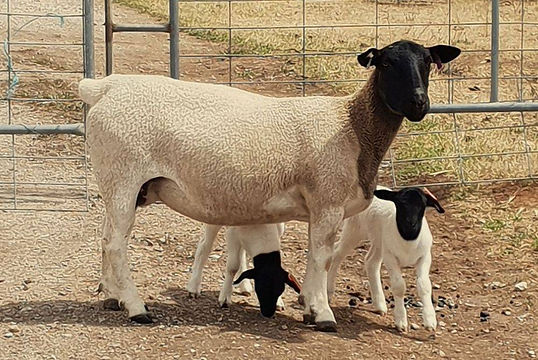
Good Mothering Qualities
A Dorper ewe will nurture their lambs under different conditions. The ewes should lamb easily, and will retain and look after their lambs. The dorper does not lose her lamb easily, even if they are handled soon after lambing. We mark (Tag & Dock Tails) our lambs within the first 48 hours after the birth. The mortality rate in the Dorper is low. We successfully lamb between 130%- 150%.
Covering
This is a very important aspect of our stud, as the shedding ability of our animals directly influences our labour costs.
We only shear our show animals prior to an event as this is a stipulation of the show organisers. Hopefully one day we may be able to put Dorpers which are in their natural state, in the ring.
The preferred amount of shedding we seek is approximately 85- 95% this enables our Dorpers to maintain a small amount of fleece on their backs for protection from the elements.


General Appearance
The Dorpers appearance is very appealing, and easy to care for. As you can see in this photo our children adore these animals and they are a pleasure to observe and work with.
"Give them plenty of space with good grazing and clean water, and they will give you a good return on your investment"

Brad & Danielle McIntosh
M: 0408 445 221 or 0411 638 346
A: 6405 Murray Valley Highway,
WYUNA - VICTORIA- AUSTRALIA
Inspections by appointment welcome!